
How to Identify Vegan Sneakers: The Complete Guide
A sneaker without animal leather is not necessarily a vegan sneaker. Between the glue, finishes, and composite materials, a pair of sneakers can contain animal-derived components without any indication on the label. In recent years, the offerings have expanded and the topic has become much clearer, but grey areas persist. Conversely, a 100% vegan sneaker can have a disastrous environmental impact if it's made on the other side of the world from virgin plastic.
This guide provides you with the complete method for recognizing a vegan sneaker: materials to look for, those to avoid, trusted labels, the right questions to ask a brand, and criteria for choosing a pair that will truly last. Goal: make an informed purchase, without falling for greenwashing.

What exactly is a vegan sneaker?
A vegan sneaker is a shoe that contains no animal-derived materials, neither in its visible nor its hidden components. No leather, no suede, no wool, no silk, no glue made from gelatin or fish skin. The goal is simple: to wear a pair for which no animal has paid the price.
It's a binary definition: the material is either animal-derived or it isn't. This is precisely what makes it demanding: just one element, a glue, a reinforcement, a logo, is enough for a sneaker to lose its vegan status. In English, we talk about vegan shoes: the same logic applies to the rest of the wardrobe, from clothing to accessories, and beauty products.
Not to be confused with "eco-responsible." Vegan is an ethical issue related to animals; ecology is a matter of resources, water, carbon, and waste. The two often overlap, but not always — we'll come back to this in detail below. A pair can also be vegan without being durable, and vice versa.
How to recognize a vegan sneaker? The 5-point method
There is not yet a standardized composition label for shoes, as there is for textiles. Therefore, reading the label alone will never be enough. Here's the approach to follow, from the quickest to the most reliable.
1. Look at the regulatory pictograms
European regulations require labeling on three parts of the shoe: the upper, the lining and insole, and the outsole. Each part is represented by a pictogram associated with a material symbol: a stretched diamond-shaped skin indicates animal leather, a hatched diamond indicates coated leather, a weave indicates textile, and a solid diamond indicates "other materials" (plastic, rubber, synthetic or plant-based materials). A solid diamond on all three areas is a good sign, but it says nothing about the glue or laces.
2. Read the entire product description
On a reputable website, the product description details each material, its origin, and its percentage. Transparent brands now provide this information without needing to be asked. Conversely, a brand that only mentions "synthetic materials" or "innovative materials" without further clarification is hiding something from you — often because the answer is "petroleum." A good product sheet will give you the composition of the upper, lining, sole, laces, and glue.
3. Check for vegan certification
This is the quickest and most reliable point: a label issued by a third-party organization like PETA Vegan Approved is worth more than ten marketing arguments. Details of recognized labels are further down in this article.
4. Track down invisible components
Glue is the number one blind spot. It's rarely a selling point, it doesn't appear on any label, and it can contain gelatin from bovine bones. Look for "natural latex-based glue" or "vegetable glue": many workshops use it today, for example, for sole assembly. Other elements to check: eyelets, heel reinforcements, brand patches, lace wax, and any care or treatments applied in finishing.
5. Just ask the question
A customer service that responds in detail, with material names and suppliers, is a huge sign of transparency. An evasive answer is also a sign, in the opposite direction. In-store, the salesperson should be able to answer you; online, the customer service email address, user comments and reviews, and social media (Instagram first and foremost) are your best allies for testing a brand's responsiveness to these questions.
What materials are used for a vegan sneaker?
Identifying a vegan shoe begins with examining the materials used in its manufacture. Not all are equal: some are excellent, others are vegan on paper but environmentally catastrophic.
Bio-based materials from fruits and plants
This is the most interesting innovation in the sector. From residues of the agri-food industry or low-water crops, recent processes create flexible and resistant alternatives to leather:
- Cactus leather — made from nopal, a plant that grows without irrigation. Given a matte finish, very close to grained leather.
- Grape leather — reuses grape marc from the wine industry, a fruit transformed into material.
- Pineapple leather — made from pineapple leaf fibers, a harvest residue.
- Cork — harvested without felling the tree, rot-proof, lightweight, used for insoles or uppers.
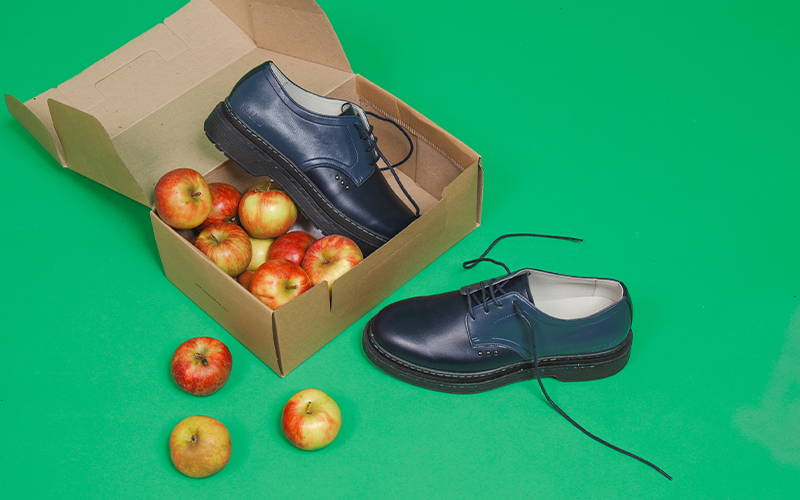
- Apple leather — made from apple pomace, a waste product from kitchens and industrial juices. This is the material ME.LAND chose for its Chelsea LANDER boots, its RANDO Derbies and the MEAKER sneakers embroidered with stars, born from a collaboration with Mademoiselle Pimpante.
⚠️ A point of caution to observe: many of these innovative materials still contain a portion of polyurethane to hold them together. Ask for the percentage of actual plant material. An honest brand will provide it.
A useful clarification: legally, in France, the word "leather" is reserved for tanned animal skin. The term "apple leather" is a commercial use, not an official designation.

Natural and organic textiles
Cotton is a safe bet for sneaker textiles. Demand organic cotton or organic cotton: conventional cotton is one of the most water and pesticide-intensive crops in the world. Hemp, linen, and Tencel are excellent options, as is upcycled denim. ME.LAND makes some models from second-life jeans collected from customers. Feel free to bring us your old blue jeans!
Recycled materials
Recycling allows us to avoid virgin plastic without sacrificing technical performance:
- Recycled nylon and polyester: made from PET bottles or fishing nets recovered from the sea. ME.LAND works with SEAQUAL nylon, made from plastic waste collected in the ocean, and donates €1 to SEAQUAL INITIATIVE for every pair of vegan sneakers sold. A direct gesture for marine ecosystems and coral reefs.
- Recycled rubber soles: production scraps and crushed PET caps, rather than new rubber.
Synthetics: handle with caution
The most common vegan leather remains polyurethane (PU) imitation leather or, worse, PVC. Technically vegan, it's made from petroleum oil, degrades quickly, and releases microplastics. PVC should be banned. If your pair contains PU, at least check that it is OEKO-TEX Standard 100 certified: this label guarantees the absence of harmful substances for the skin.
Glue and finishes
Vegan glue made from natural latex is the only way to guarantee assembly without animal origins. For vegan running and sports models, where the assembly technique matters, this is a point to systematically check.
Top materials to prioritize in a vegan sneaker
✅ Bio-based materials: apple, cactus, grape, pineapple, cork
✅ Organic cotton, hemp, linen, upcycled denim
✅ Certified recycled nylon and polyester
✅ Recycled rubber
✅ Plant-based or recycled suedine
✅ Natural latex-based glue
✅ OEKO-TEX certified synthetics, if not other options
What materials to avoid in a vegan shoe?
To ensure a pair is truly vegan, you need to know the common materials that compromise this status. There are more of them than you might think.
❌ Animal leather in all its forms: smooth leather, grained leather, nubuck, suede, velvet, reversed leather. Vegetable tanning changes nothing: the base remains animal skin.
❌ Wool, felt, and sheepskin lining: common on winter models and high-top shoes.
❌ Animal-derived glues: gelatin from bovine bones, fish skin-based glues. Invisible, and rarely mentioned.
❌ Fur, including synthetic: fake fur is vegan, but generally made from virgin plastic: the ethical gain comes at the cost of pollution. Opt for bio-based faux fur made from corn.
❌ Low-quality synthetics: PVC and uncertified PU, which crack in one season. A disposable shoe is never a good choice, even if it's vegan.
❌ Silk, mother-of-pearl, and bone: on decorative elements, buttons, and eyelets.
What are the vegan labels?
Certifications issued by independent organizations are the best way to guarantee that a pair is vegan, and not just presented as such. Two labels are authoritative in the field.
PETA - Vegan Approved
The PETA-Vegan Approved label certifies the total absence of animal-derived components in the finished product and in its manufacturing process. It is the most visible on vegan sneakers and the easiest to spot on a product sheet. PETA maintains an online directory of certified brands.
The Vegan Society trademark
The Vegan Society, a British organization founded in 1944, issues the Vegan trademark — the green sunflower. Strict control, including on animal testing. It's the historical reference, a little less common on footwear than on food and beauty products, but very reliable.
Additional labels to know
They do not certify the vegan nature, but usefully complete the identity card of a pair:
- GOTS — organic cotton and social requirements throughout the chain.
- OEKO-TEX Standard 100 — absence of harmful substances in fabrics.
- SEAQUAL INITIATIVE — traceability of plastic recovered from the sea.
- REFASHION and LEKO — eco-organizations in the sector, management of end-of-life and product recycling.
- Fairtrade — fair trade for raw materials.
💡 Pro tip: Before any purchase, always verify certifications on the brand's website or on the label. A logo displayed without a certification number or dedicated page deserves verification. ME.LAND is PETA VEGAN APPROVED, OEKO-TEX, SEAQUAL INITIATIVE, REFASHION, and LEKO certified — each reference is available on the site's commitments page.
What are the environmental impacts of vegan sneakers?
This is the point most articles overlook: a vegan sneaker is not automatically ecological. The sole criterion of "no animal materials" says nothing about the actual footprint of a pair.
What veganism truly achieves
Intensive farming accounts for approximately 14.5% of global greenhouse gas emissions according to the FAO, and tanneries are among the most polluting industries in the world. 85% of global leather is chrome-tanned, with the resulting water discharge. A pair without animal leather mechanically avoids this part of the environmental impact. On this front, the gain for the planet is not theoretical: it means less land, water, and inputs.
What veganism doesn't solve
- Petroleum: a 100% PU sneaker remains a petrochemical product with a high carbon footprint, non-biodegradable.
- Durability: a pair that lasts three months generates more waste than three pairs that last three years. Assembly quality is an ecological criterion in its own right.
- Transportation: production on the other side of the world negates a large part of the material benefit.
- Working conditions: fashion ethics are not limited to animals. Factories must offer fair working conditions, in Asia as in Europe, Africa, or South America.
- End-of-life: a multi-material glued sneaker is almost impossible to recycle. Eco-designed models prioritize single-component materials and replaceable soles.
The true marker: proximity of the production chain
The most responsible brands shorten their distances. ME.LAND designs in Paris and manufactures in an audited family workshop in Felgueiras, northern Portugal, using 100% European materials sourced in Spain and Portugal, mainly within a 50 km radius of the workshop. The result: a very low transport carbon footprint and verifiable traceability. Zero-waste logic applied even to rubber scraps reincorporated into the soles.
A word on "made in France": the French shoe industry has almost disappeared for sneakers, and many pairs stamped "French" are simply assembled in France from imported components. Traced European manufacturing, close to its suppliers, is often more virtuous than a superficial "made in France." Ask about the exact location of the workshop; it's an excellent transparency test.

How to choose a vegan sneaker? The 7 criteria
- Detailed composition: announced material percentages, no artistic vagueness.
- Labels: at least one vegan certification, ideally complemented by OEKO-TEX or GOTS.
- Place of manufacture: named workshop, specified country, documented working conditions.
- Durability: stitching, assembly quality, possibility of resoling. A good pair can be repaired.
- Use: urban, sport, running, hiking, summer sandal: the range and support are not the same. A minimalist white sneaker is not chosen like a running shoe.
- Size and comfort: bio-based materials stretch less than animal leather. Take your usual size and check the size guide; color and style should not take precedence over fit.
- Price relative to lifespan: a €60 pair changed every year costs more, and costs the planet more, than a €160 pair worn for four years. The price of an eco-designed sneaker reflects rare materials and fairly paid European labor. It remains accessible when compared to the number of times the pair will be worn.
Which vegan sneaker brands? How to evaluate them
A ranking of "best" brands quickly becomes outdated and depends on your needs, so here's a framework to assess any brand within five minutes of browsing their website:
- A dedicated commitments page, clear, quantified, with supplier names. Vague content is a negative signal.
- The vegan certification displayed with the organization that issues it.
- Is the entire collection vegan, or only a few models? Many brands offer different lines, a vegan one alongside a leather one: this is not disqualifying, provided it is clearly stated on each product page.
- Is advice handled well? Responsive customer service, a blog that explains instead of sells.
- Reviews and observed durability, comments after a year of wear are better than those from the day of order.
ME.LAND ticks these boxes on its vegan sneaker collection: bio-based and recycled materials, 100% vegetable latex glue, traceable European manufacturing, verifiable certifications. The selection covers daily needs, from VIVACE and EVAN models, to LANDER and RANDO apple leather shoes, for both women and men.
Where to buy vegan sneakers?
Directly on the brand's website. This is where the information is most complete: composition, labels, manufacturing workshop, return policy. It also best compensates committed brands, who do not have the margins to absorb platform commissions.
On specialized online stores. Several vegan shops and ethical concept stores bring together brands selected based on verified criteria. Practical for comparison, provided the information is cross-checked with the brand's website.
In physical stores. Trying them on remains irreplaceable for size and comfort. Responsible fashion stores are multiplying in large cities; the salesperson should be able to detail the materials to you.
Second-hand. This is the most minimalist option: no new production, no new materials. Look for the exact model and check its original composition on the brand's website before buying.
💡 For children, whose small feet grow quickly, second-hand and resale are particularly relevant.
Why choose vegan sneakers?
- For animals: this is the primary reason, and it is sufficient in itself for many people.
- To avoid chrome tanning: less water pollution, better sanitary conditions for tannery workers.
- To support material innovation: each pair of apple, cactus, or grape leather finances a nascent industry that revalues agricultural waste.
- For consistency: if your lifestyle is already plant-based in terms of food, your wardrobe logically follows suit (clothes, accessories, shoes).
- For performance: today's plant-based and recycled materials have nothing to do with the rigid faux leather of ten years ago. Flexibility, breathability, design: the level of quality is there.
FAQ — your questions about vegan shoes
Is a vegan sneaker more fragile than a leather sneaker?
Not necessarily. A low-end faux leather will wear out faster than good leather, but a quality bio-based material, well assembled, will last perfectly for several years. It is the quality of manufacturing, more than the nature of the material, that determines the lifespan.
How to care for vegan sneakers?
Dry brushing, a damp cloth, and mild soap at home are sufficient in most cases. Avoid washing machines, which loosen assemblies, and leather care products, which are often animal wax-based. Air dry, never on a radiator.
How do I know if my already purchased sneakers are vegan?
Find the exact model reference and search for its product page on the brand's website or do a web search for the model name + "vegan." Failing that, the brand's customer service remains the most reliable source.
Are there vegan sports and running sneakers?
Yes. Most performance shoes are already made of nylons and polyesters, so they are free of animal materials — it remains to check the glue and prioritize versions made of recycled and OEKO-TEX certified materials.
Is vegan and eco-responsible the same thing?
No. A vegan sneaker can be 100% petroleum-based and manufactured on the other side of the world. To learn more about this topic, read our guide "What is a vegan sneaker? Everything you need to know."
The essentials:
Recognizing a true vegan sneaker requires going beyond the commercial argument: reading the full composition, checking labels, tracking glue and finishes, and asking direct questions to the brand. A truly virtuous pair ticks three boxes at once: free of animal-derived materials, made with low-impact materials, and manufactured under ethical and traceable conditions.
It's demanding, but it's what separates a truly committed purchase from a greenwashed one. And once the reading grid is acquired, a few minutes are enough to decide.
👉 Discover the ME.LAND vegan sneaker collection: bio-based materials, plant-based glue, traceable European manufacturing.